選煤廠污水處理案例解析(含壓濾機(jī)應(yīng)用)
一、選煤污水的危害分析
二、選煤污水的組成與特性
三、選煤污水處理的核心標(biāo)準(zhǔn)與復(fù)用要求
四、壓濾機(jī)在選煤污水處理中的核心應(yīng)用
五、選煤污水處理常用藥劑與適配技巧
六、案例總結(jié)
]]>
養(yǎng)殖廢水處理改造工程案例_50m3/d奶牛養(yǎng)殖廢水達(dá)標(biāo)回用項(xiàng)目
一、工程概況
二、設(shè)計(jì)進(jìn)水水量及水質(zhì)
三、污水處理排放標(biāo)準(zhǔn)
四、工藝設(shè)計(jì)分析
五、工藝流程及說明
(一)工藝流程
(二)工藝說明
]]>
高效隔膜板框壓濾機(jī)市政污泥工程案例
一、引言
在當(dāng)前環(huán)保治理不斷升級的背景下,污泥脫水干化作為河湖清淤、城市污水處理中的關(guān)鍵環(huán)節(jié),其處理效率、處理質(zhì)量及成本控制直接影響工程整體效益。目前,國內(nèi)外主流的機(jī)械脫水干化技術(shù)主要分為帶式壓濾機(jī)脫水、離心機(jī)脫水和板框壓濾機(jī)脫水三大類。其中,高效隔膜板框壓濾機(jī)在普通板框式壓濾機(jī)的基礎(chǔ)上進(jìn)行了全方位優(yōu)化改進(jìn),具備自動化程度高、泥餅含水率低、生產(chǎn)效率高、運(yùn)行穩(wěn)定、處理成本低等核心優(yōu)勢,已逐漸成為河湖污泥處理、城市污水處理等領(lǐng)域的優(yōu)選設(shè)備,在國內(nèi)得到廣泛應(yīng)用與推廣。
二、高效隔膜板框壓濾機(jī)工作原理
高效隔膜板框壓濾機(jī)的工作原理簡潔且高效,核心結(jié)構(gòu)由交替排列的濾板和濾框組成一組完整濾室。濾板表面設(shè)有專用溝槽,其凸出部位用于支撐濾布,濾框與濾板的邊角處均設(shè)有通孔,組裝后可形成完整的流體通道,用于通入懸浮液、洗滌水及引出濾液。濾板與濾框兩側(cè)的把手支托在橫梁上,通過壓緊裝置將濾板與濾框緊密壓緊,濾板與濾框之間的濾布同時(shí)起到密封墊片的作用,保障過濾過程的密封性。
具體工作流程分為四個(gè)階段:一是壓緊階段,通過液壓系統(tǒng)將濾板、濾框緊密壓緊,形成密封濾室;二是進(jìn)料階段,由供料泵將懸浮液壓入濾室,濾渣在濾布表面逐漸沉積形成泥餅,直至濾室被完全填充;三是過濾階段,濾液穿過濾布,沿濾板表面的溝槽流至邊角通道,實(shí)現(xiàn)集中排出;四是卸渣與循環(huán)階段,過濾完成后,松開壓緊裝置,卸除濾渣、清洗濾布,重新壓緊濾板與濾框,進(jìn)入下一個(gè)工作循環(huán)。整個(gè)流程實(shí)現(xiàn)自動化運(yùn)行,操作便捷,大幅減少人工干預(yù)。
三、核心應(yīng)用參數(shù)
高效隔膜板框壓濾機(jī)的應(yīng)用效果,與進(jìn)料參數(shù)、工藝優(yōu)化密切相關(guān),核心應(yīng)用參數(shù)如下:
1. 泥漿濃度與調(diào)理:針對城市湖泊、河道疏浚的泥漿,初始質(zhì)量濃度通常約為8%,濃度較低,直接處理會導(dǎo)致效率低、電耗高。為提升處理效益,需先對泥漿進(jìn)行濃縮、調(diào)理處理,處理后泥漿質(zhì)量濃度可提升至25%,此舉可使壓濾機(jī)脫水效率提升150%以上,有效降低運(yùn)行成本。
2. 進(jìn)料工藝優(yōu)化:板框壓濾機(jī)單個(gè)周期處理的固體污泥量,通常為設(shè)計(jì)最大值的85%~100%,即濾室腔體的污泥充盈率,充盈率越高、進(jìn)料時(shí)間越短,生產(chǎn)效率越高。工程中常用渣漿泵作為供漿設(shè)備,經(jīng)工藝優(yōu)化后,采用雙進(jìn)料泵供漿模式可進(jìn)一步提升效率:供漿初期采用高流量低揚(yáng)程渣漿泵,快速填充濾腔,當(dāng)充盈率達(dá)到85%以上后,切換為低流量高揚(yáng)程渣漿泵,在進(jìn)一步壓榨淤泥的同時(shí),提升濾腔充盈率,增加固體污泥處理量。
四、工程實(shí)例
(一)工程概況
湖泊清淤項(xiàng)目,總設(shè)計(jì)清淤方量約102萬m3,項(xiàng)目核心需求為實(shí)現(xiàn)污泥脫水干化一體化處理,確保處理后濾餅含水率不大于40%,尾水懸浮物含量不大于20mg/L,最終實(shí)現(xiàn)污泥減量化、無害化處理,滿足環(huán)保排放及后續(xù)處置要求。該項(xiàng)目選用高效隔膜板框壓濾機(jī)作為核心脫水設(shè)備,構(gòu)建完整的脫水干化工藝體系。
(二)施工工藝
1. 污泥濃縮與調(diào)理:該湖泊疏浚泥漿初始質(zhì)量濃度約為8%,首先通過自然重力沉淀方式進(jìn)行濃縮處理,濃縮后泥漿質(zhì)量濃度提升至25%,脫水效率較初始狀態(tài)提升200%以上。濃縮后的污泥進(jìn)入調(diào)節(jié)池,向池內(nèi)添加生石灰與粉煤灰組合固化劑(其中生石灰占濾餅比重2%,粉煤灰占濾餅比重3%)。該組合固化劑可有效破壞污泥的親水膠體結(jié)構(gòu),改善污泥脫水特性,同時(shí)優(yōu)化污泥孔隙結(jié)構(gòu),增強(qiáng)污泥透水性,進(jìn)一步提升壓濾機(jī)脫水速率。固化劑與污泥在調(diào)節(jié)池內(nèi)充分?jǐn)嚢杌旌暇鶆蚝螅稍鼭{泵輸送至高效隔膜板框壓濾機(jī)進(jìn)行脫水干化處理。
2. 壓濾脫水過程:高效隔膜板框壓濾機(jī)單個(gè)工作循環(huán)主要分為5個(gè)步驟,依次為:壓緊濾板→進(jìn)料→隔膜壓榨→反吹→卸料,完成后重新壓緊濾板進(jìn)入下一個(gè)循環(huán)。具體操作如下:進(jìn)料前由液壓系統(tǒng)將濾板緊密壓緊,確保密封;進(jìn)料初期采用高流量渣漿泵供漿10~15分鐘,將濾室腔體基本填充完畢后,切換為高揚(yáng)程渣漿泵供漿5~10分鐘;關(guān)閉進(jìn)料泵,開啟壓榨閥門,維持壓榨壓力在1MPa左右,持續(xù)10~15分鐘,直至出液嘴水流由連續(xù)出水變?yōu)辄c(diǎn)滴出水,關(guān)閉壓榨閥門;打開反吹氣閥,反吹10秒左右,排出壓濾機(jī)中心進(jìn)料管內(nèi)殘留污泥及隔膜腔內(nèi)殘余濾液;壓榨結(jié)束后,壓緊板后退,通過拉板小車實(shí)現(xiàn)自動卸料。
該項(xiàng)目中,壓濾機(jī)單個(gè)循環(huán)周期約為45~60分鐘,處理后濾餅厚度可達(dá)35~40mm,濾餅含水率≤40%,尾水懸浮物含量≤20mg/L,完全滿足項(xiàng)目設(shè)計(jì)要求及相關(guān)環(huán)保標(biāo)準(zhǔn)。
五、運(yùn)行成本與工程效益
該湖泊清淤項(xiàng)目中,高效隔膜板框壓濾機(jī)的運(yùn)行成本優(yōu)勢顯著。經(jīng)核算,單噸污泥處理成本約為44.46元,遠(yuǎn)低于傳統(tǒng)污泥石灰干化技術(shù)(單噸處理成本約93.7元)、離心機(jī)脫水技術(shù)(單噸處理成本約92.26元)及帶式壓濾機(jī)脫水技術(shù)(單噸處理成本約242.84元),大幅降低了工程整體運(yùn)行成本,具備極強(qiáng)的經(jīng)濟(jì)效益。
六、結(jié)論
高效隔膜板框壓濾機(jī)脫水干化技術(shù),是一種低成本、高效率、高穩(wěn)定性的城市污泥及河湖淤泥處理解決方案,其自動化運(yùn)行模式可減少人工成本,低含水率濾餅可實(shí)現(xiàn)污泥減量化,低成本優(yōu)勢可提升工程整體效益,完全滿足當(dāng)前環(huán)保治理的核心需求。
本次清淤工程的實(shí)踐表明,高效隔膜板框壓濾機(jī)脫水干化工藝運(yùn)行穩(wěn)定、處理效果達(dá)標(biāo)、經(jīng)濟(jì)效益顯著,應(yīng)用取得了圓滿成功。該工程的施工經(jīng)驗(yàn)、工藝參數(shù)及成本控制方法,可為國內(nèi)同類河湖清淤、城市污水處理項(xiàng)目提供可靠的參考依據(jù),助力環(huán)保工程提質(zhì)增效,推動污泥處理行業(yè)高質(zhì)量發(fā)展。
壓濾機(jī)咨詢:18851718517
]]>
在當(dāng)前工業(yè)生產(chǎn)和環(huán)保治理不斷升級的背景下,filter press作為重要的固液分離設(shè)備,市場需求持續(xù)增長。選擇一家實(shí)力可靠、技術(shù)成熟的壓濾機(jī)廠家,成為眾多企業(yè)關(guān)注的重點(diǎn)。蘇東壓濾機(jī)廠家立足行業(yè)多年,專注于壓濾機(jī)設(shè)備的研發(fā)、制造與服務(wù),為客戶提供穩(wěn)定、高效的壓濾解決方案。
一、蘇東壓濾機(jī)廠家的定位與實(shí)力
蘇東壓濾機(jī)廠家是一家集設(shè)計(jì)、生產(chǎn)、銷售于一體的專業(yè)壓濾機(jī)制造企業(yè),主要產(chǎn)品包括廂式壓濾機(jī)、板框壓濾機(jī)、隔膜壓濾機(jī)及全自動壓濾機(jī)等。廠家依托成熟的生產(chǎn)體系和技術(shù)團(tuán)隊(duì),不斷提升產(chǎn)品性能,滿足不同行業(yè)用戶對過濾效率和設(shè)備穩(wěn)定性的要求。
在生產(chǎn)過程中,蘇東壓濾機(jī)廠家注重設(shè)備的實(shí)用性與耐用性,通過合理的結(jié)構(gòu)設(shè)計(jì)和嚴(yán)謹(jǐn)?shù)难b配工藝,使壓濾機(jī)在高強(qiáng)度工況下依然能夠保持穩(wěn)定運(yùn)行。
二、產(chǎn)品結(jié)構(gòu)與技術(shù)優(yōu)勢
蘇東壓濾機(jī)廠家生產(chǎn)的壓濾機(jī)在結(jié)構(gòu)設(shè)計(jì)上科學(xué)合理,過濾面積配置靈活,能夠根據(jù)客戶物料特性進(jìn)行選型。濾板采用高強(qiáng)度材料,耐壓性能好,密封效果可靠,有效降低跑料和漏料現(xiàn)象。
同時(shí),液壓系統(tǒng)運(yùn)行平穩(wěn),壓緊力穩(wěn)定,確保過濾過程連續(xù)高效。電控系統(tǒng)操作簡便,支持自動進(jìn)料、壓緊、卸料等流程,降低人工操作強(qiáng)度,提高生產(chǎn)效率。
三、廣泛的應(yīng)用領(lǐng)域
憑借穩(wěn)定的性能和良好的適應(yīng)性,蘇東壓濾機(jī)廠家產(chǎn)品已廣泛應(yīng)用于環(huán)保污水處理、污泥脫水、化工過濾、礦山選礦、食品加工等多個(gè)行業(yè)。針對不同行業(yè)物料含固量、顆粒大小及腐蝕性的差異,廠家可提供針對性的壓濾機(jī)配置方案,幫助客戶實(shí)現(xiàn)理想的過濾效果。
四、嚴(yán)格的質(zhì)量控制體系
蘇東壓濾機(jī)廠家始終將產(chǎn)品質(zhì)量放在重要位置,從原材料采購到成品出廠,均執(zhí)行嚴(yán)格的質(zhì)量檢測流程。每一臺壓濾機(jī)在出廠前都需經(jīng)過試運(yùn)行和性能檢測,確保設(shè)備各項(xiàng)指標(biāo)符合設(shè)計(jì)要求,為客戶長期穩(wěn)定使用提供保障。
五、完善的服務(wù)與支持
在服務(wù)方面,蘇東壓濾機(jī)廠家建立了完善的售前、售中、售后服務(wù)體系。售前階段,技術(shù)人員根據(jù)客戶工況提供選型建議;設(shè)備交付后,提供安裝指導(dǎo)與操作培訓(xùn);使用過程中,售后團(tuán)隊(duì)可及時(shí)響應(yīng)客戶需求,協(xié)助解決設(shè)備運(yùn)行問題。
六、持續(xù)發(fā)展與未來方向
隨著行業(yè)技術(shù)不斷進(jìn)步,蘇東壓濾機(jī)廠家將持續(xù)推進(jìn)產(chǎn)品升級和技術(shù)創(chuàng)新,在提高自動化水平、降低能耗、延長設(shè)備使用壽命等方面不斷優(yōu)化,為客戶創(chuàng)造更高的使用價(jià)值。
concluding remarks
綜合來看,蘇東壓濾機(jī)廠家憑借扎實(shí)的制造基礎(chǔ)、穩(wěn)定的產(chǎn)品性能和完善的服務(wù)體系,已成為眾多企業(yè)信賴的壓濾機(jī)供應(yīng)商。未來,廠家將繼續(xù)深耕壓濾機(jī)領(lǐng)域,為工業(yè)生產(chǎn)和環(huán)保事業(yè)提供更加可靠的設(shè)備支持。
]]>
【行業(yè)領(lǐng)先技術(shù)】蘇東壓濾機(jī)采用高強(qiáng)度濾板與智能控制系統(tǒng),實(shí)現(xiàn)高效固液分離,過濾精度高,處理能力強(qiáng),廣泛應(yīng)用于化工、冶金、環(huán)保、食品等領(lǐng)域,滿足不同行業(yè)的過濾需求。
【節(jié)能耐用設(shè)計(jì)】優(yōu)化結(jié)構(gòu)設(shè)計(jì),能耗降低30%,運(yùn)行更穩(wěn)定;選用耐磨抗腐蝕材料,設(shè)備壽命大幅延長,減少維護(hù)成本,為企業(yè)創(chuàng)造長期價(jià)值。
【智能自動化操作】配備PLC智能控制,一鍵啟停,實(shí)時(shí)監(jiān)控運(yùn)行狀態(tài),操作簡便,安全可靠,大幅提升生產(chǎn)效率,降低人工成本。
【定制化服務(wù)】根據(jù)客戶需求提供個(gè)性化方案,支持濾板材質(zhì)、過濾面積等靈活配置,確保每一臺壓濾機(jī)都能精準(zhǔn)匹配生產(chǎn)要求。
選擇蘇東壓濾機(jī),就是選擇高效、節(jié)能、省心的過濾專家!立即咨詢,獲取專屬解決方案!
關(guān)鍵詞:壓濾機(jī)、高效過濾設(shè)備、固液分離機(jī)、工業(yè)壓濾機(jī)、蘇東壓濾機(jī)廠家、智能壓濾機(jī)、化工過濾設(shè)備
]]>1 Diaphragm filter press workflow and principle
The diaphragm filter press duty cycle is divided into the feed stage, the filter press stage, the membrane drum stage, the blowback stage, the discharge stage, and the preparation stage for the next duty cycle, such as cleaning the filter cloth and pressing the filter plate. The diaphragm filter press operating cycle timeline is shown in Figure 1. The blowback, discharge, and preparation phases have a constant time, which is integrated for ease of calculation and is referred to as T0. The feed phase time, T1, starts when the sludge is pumped to the filter press and fills the entire chamber, which is also a constant value. The filter press stage time T2 starts at 0 and stops at t2, when the sludge continues to be fed at the rated pressure P2 and filtered. At T3, the filter press stops feeding, the diaphragm plates on both sides of the diaphragm are filled with water or air at rated pressure p3 (p3 > p2) to expand the diaphragm chamber, compressing the volume of the sludge cake inside the chamber and further filtering the sludge cake until t3.
Since the filtration speed in the filter press and membrane drum stages decreases with time, the efficiency of the filter press in treating sludge begins to decrease in the later stages of operation. Therefore, the efficiency of the diaphragm filter press can be improved by optimising the filter press time T2 and the membrane drum time T3.
2 Based on Fluent simulation of filter press working process
The purpose of this simulation is to simulate the filtration process of the filter press, record the filtrate volume at each time point, and find out the relationship between the filtrate volume and time in the filtration stage, the specific filtration speed[2, 7-8] and time, and the relationship between the filtration pressure and the limiting filtration volume of the sludge, so as to provide a basis for the prediction of the mathematical model for the other working stages of the filter press.
2.1 Establishment of Filter Chamber Models Fluent pre-processing was carried out using Gambit software to establish the geometric model of a single filter chamber of the filter press and mesh the chamber. The calculation method was "Standard k-ε model", the discrete format was "QUICK", the pressure interpolation method was "PRESTO! The pressure interpolation method is "PRESTO!" and the pressure-velocity coupling method is "PISO". The main parameters were as follows: chamber diameter of 300 mm; solid-phase particle diameter of 0.01 mm; chamber thickness of 10 mm; rated filtration pressure of 0.2-3.0 MPa; solid-phase density of 1,051 kg/m3; filtration time of 30 min; porosity of 201 TP3T; two-phase flow rate of 951 TP3T; and coefficient of inertial resistance of 3.5×10⁷ ; The coefficient of inertial resistance is 3.5×10⁷; the coefficient of viscosity resistance is 1.2×10¹⁵; and the dynamic viscosity is 0.02 Pa?s.
2.2 Simulation results Under the filtration pressure of 0.2~1.4 MPa, the relationship between the total volume of filtrate V and time t of the four groups is shown in Fig. 2. As can be seen from Fig. 2, the total volume of filtrate gradually increases with time and tends to be close to a certain limit value; the higher the pressure, the faster the filtrate speed, and the greater the ultimate filtration volume.The liquid-phase flow velocity in the outer cross-section of the porous medium is plotted at a filtration pressure of 1.4 MPa. The specific filtration velocity q versus time t is shown in Fig. 4. From Fig. 4, it can be seen that the specific filtration velocity will surge to a certain value at the beginning, continue to rise for a short period of time, reach the maximum value, and then gradually decrease with the increase of time; the main reason for the transient increase of the specific filtration velocity is that the sludge particles are bonded at the beginning of the filtration process, and the diameter of the particles increases, which leads to the decrease of the specific surface area of the sludge layer and the increase of the porosity.
3 Mathematical modelling of two-phase flow filtration
3.1 Conventional filtration calculation methods
The traditional method of measuring specific resistance usually considers the mud cake incompressible and measures the slope of the curve K of dt/dV-V[12] , which is derived as a proportional function of K[6, 13] . The specific resistance r is derived as a proportional function of K [6, 13], which leads to the specific resistance r. However, this method regards the cake as incompressible and the specific resistance does not change with time, which is obviously not consistent with the filtration situation of two-phase flow of sludge in the filter chamber of the diaphragm filter press. In addition, the diaphragm filter press has many workflows, the filtration stage is a constant-pressure feed filtration, and the volume of the filter chamber in the membrane drum stage changes with time, which makes the variation of the specific resistance complicated, and it is difficult to express the relationship between q and t in equation (3).
3.2 Calculation method based on the simulation results By simulating and recording the curve of the total volume of sludge filtrate V(t) versus time t and the curve of the specific filtration rate q versus time t, the expression of the V-t function is obtained by fitting the calculation.
3.2.1 Feed stage During the feed stage, the filtration volume is approximated to be 0 L. The sludge is fed at a certain flow rate to reach the final M1, which is the chamber volume.
From its derivative (Figure 4), it can be seen that: first there will be a short-term increase, and then gradually decrease, and finally converge to 0 L. Therefore, the exponential form is more in line with the change rule of the total amount of filtrate over time, and can be fitted to the V(t)-t curve of the filtration pressure stage by the least squares method. Set 2 / 22 22 2 ( ) e , 0, 0, 0, 0 b t Vt a a b t t = ><< ≤ (4) The simulated V2-t curves of 8 groups under the conditions of 0.2~3.0 MPa are fitted by the least squares method, and the results are shown in Table 1. From Table 1, the curves of filtration pressure p2 and parameter a2 are shown in Fig. 5. The ultimate filtration capacity a2 increases with the increase of pressure, but the rate of increase is from fast to slow, and tends to a constant value, after reaching the constant value, the further increase of pressure can not make the mud cake further filtration[14] .
The parameter b2 hardly changes with filtration pressure under certain sludge characteristics and filter press operating parameters. 3.2.3 Membrane Stage Assuming that the filter press continues to be fed at the pressure p3 during the membrane stage, the ultimate filtrate volume a3 = ka2 (where k is the ratio of the membrane filtrate volume to the filtration filtrate volume). However, the membrane stage stops feeding, the diaphragm plate with a certain pressure on the compression of the cake, by reducing the volume of the filter chamber to achieve the purpose of filtration, the limit of the filtrate volume must be less than a3, so a3 is not the limit of the filtrate volume of the membrane stage. Therefore, a3 is not the limiting filtrate volume in the membrane stage. In this paper, a3 is the virtual limiting filtrate volume in the membrane stage, and V3' is the virtual filtrate volume in the membrane stage, whose value is only a mathematical assumption, not the real filtrate volume.
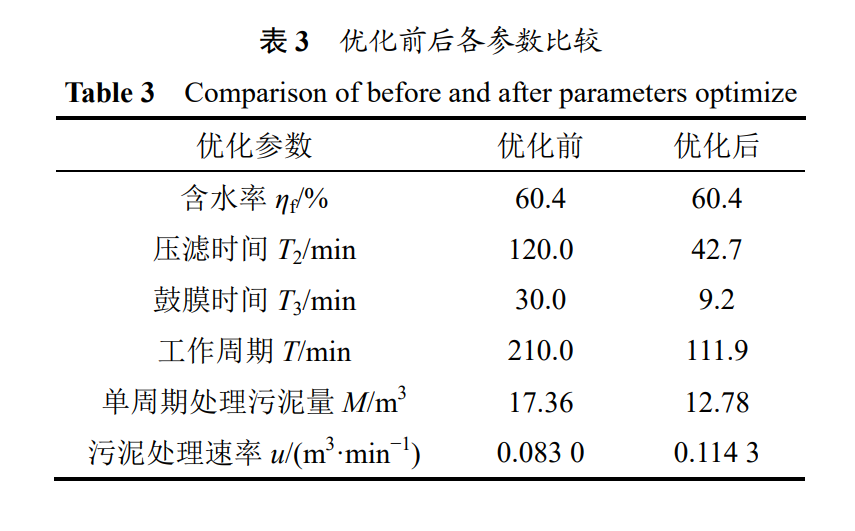
3.2.4 Filter Press Blowback, Unloading and Preparation for Cleaning After the membrane is blown, a blowback process is performed to clean the pipework of any residual slurry and filtrate. This is followed by the unloading process and preparation for the next cycle. The time for this phase is essentially constant. 3.2.5 Optimisation of filter press operating time points As shown in Figure 1, the non-filtration sum time T0+T1=t0 and the filter press filtration time T2+T3=t3, the filter press operating cycle T=t0+t3, with filtration time T2=t2 and membrane drumming time T3=t3-t2. Assuming that the original sludge water content is η0, the final water content of the cake during the drumming process at t=t3 reaches ηf, which is the final water content of the sludge dewatering process. At t=t3, the final water content of the sludge cake in the membrane drum process reaches ηf, which is the standard of sludge dewatering.
In practice, since the expansion of the diaphragm at the membrane expansion stage is not arbitrarily large, the pressure of the diaphragm plate will not be able to act sufficiently on the cake if the cake does not reach a certain thickness, which limits the scope of application of this method to calculate the optimum filter press time. Based on the above problems, the minimum feed quantity Mmin should be set according to the diaphragm expansion performance of the diaphragm plate of the diaphragm filter press, and when the theoretically calculated filtration press time T2 corresponds to the total feed quantity M>Mmin, T2 calculated by the above method is the optimal filtration press time, and T3 is the optimal membrane drumming time. When the total amount of feed M corresponding to the theoretically calculated filter press time T2 < Mmin, the time T2′ to reach Mmin is the optimum filter press time.
4 Optimisation of filter press working cycle in sludge treatment plant 4.1 Filter press working parameters A sludge treatment plant treats 500 m3 of sludge with a water content of 95% per day, and four XAGZ200/1250-30u diaphragm filter presses are designed to work simultaneously for 24 hours, which cannot actually complete the work task. At present, the working cycle of the filter press in this plant is T=210 min, in which the preparation time is 20 min, the feeding time is 10 min, the filter press time is 120 min, the membrane drum time is 30 min, the blowback time is 10 min, and the unloading time is 20 min. The parameters of the XAGZ200/1250-30u diaphragm filter press are as follows: the area is 200 m2 , the number of chambers is 80, the outer diameter of the filter plate is 10 m2 , and the number of filter plates is 10 m2 . The parameters of XAGZ200/1250-30u diaphragm filter press are as follows: the area is 200 m2 ; the number of filter chambers is 80; the outer diameter of the filter plate is 1 250 mm×1 250 mm; the thickness of the filter chamber is 30 mm; the centre feed, the rated filtration pressure is 0.8 MPa, and the rated pressing pressure is 1.6 MPa. The amount of filtrate during the working process of the filter press was recorded, as shown in Table 2.At the end of the filter press process, the total amount of filtrate was 14.36 m3 . The total amount of filtrate at the end of the drum stage was 15.17 m3 , and the water content of the final cake was 60.4%. The sludge processing rate of the filter press was u=0.083 m3 /min.
4.2 Optimisation of the timing of the various operating phases of the filter press
According to the time setting of the original filter press workflow, each filter press can work for 6 cycles per day, and the daily processing capacity of the 4 filter presses is about 416.64 m3 , which is not able to complete the daily production task. After optimisation, the working cycle of filter press is about 2 h, and the daily operation is 12 cycles, the daily production capacity can be 613.44 m3 . The plant actually operates according to the cycle proposed in this paper, and lets one of the machines rest and standby in turn while completing the task, which not only meets the requirements of the daily production.It also gives the filter presses more downtime and overhaul time, which helps to extend the service life of the filter presses.
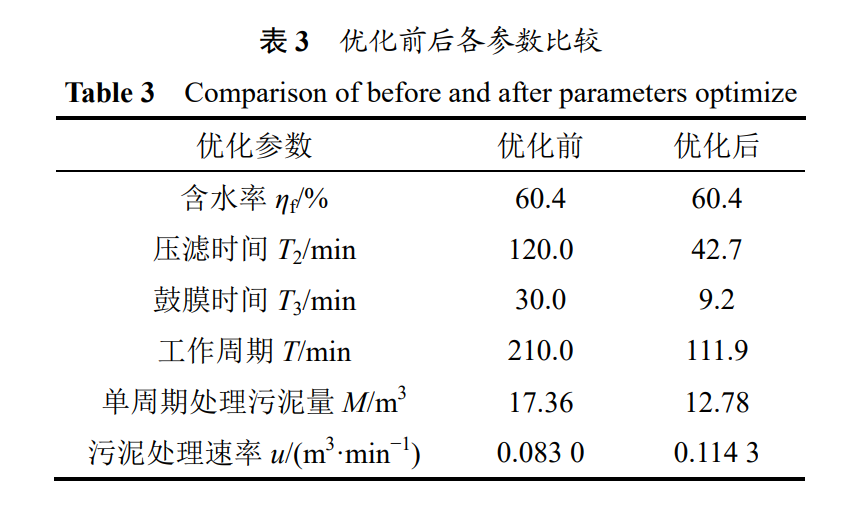
5 Conclusions 1) Based on Fluent simulationsfilter pressThe relationship between the total volume of filtrate V and time t under different pressures in the filtration stage was investigated, and a least-squares method was used to fit the functional expression of the curve to obtain the relationship between the total volume of filtrate and the pressure. 2) The concept of virtual filtrate volume V3′ in the membrane stage was proposed, i.e., the total filtrate volume under the assumption of continuing to feed at the membrane pressure p3 without changing the chamber volume. In this way, the mathematical relationship between the actual filtrate volume V3 at the membrane drum stage and the time t is obtained, and the mathematical relationship between the filter press efficiency u and the filter press time t2 is also obtained. 3) Optimising the time of each working stage of diaphragm filter press in a sludge treatment plant, the sludge treatment efficiency was improved by 37.7%.
]]>壓濾機(jī)的品牌也有很多,如蘇東,suton等
污水處理設(shè)備壓濾機(jī)的使用方法如下1::
- 濾布的選型。
- 板框壓濾機(jī)應(yīng)首先將濾布放入壓濾機(jī)中。
- 將污水進(jìn)入濾室,然后加壓將污水送入壓濾機(jī),將污泥水壓干。
- 將過濾后的清水放出。
- 將過濾室中的污泥清除,清洗濾布。
- 按照順序操作,不斷循環(huán)。
污水處理設(shè)備壓濾機(jī):18851718517
]]>- 過濾面積180平米。體積1.6立方
- It adopts PLC control to achieve automatic feeding, filtering, pressing, discharging, washing and unloading operations.
- The frame is made of carbon steel and stainless steel for corrosion resistance and long life.
- The filter plate is moulded as a whole, with good sealing and no leakage.
- Non-standard design can be carried out according to the user's needs to meet a variety of special working conditions.
180平方程控隔膜壓濾機(jī)在過濾壓力、過濾面積、過濾效果等方面都有很大的優(yōu)勢,被廣泛應(yīng)用于化工、制藥、冶金、礦山、食品、環(huán)境工程等領(lǐng)域。
]]>- 處理面積為100平米。
- 電源為380V。
- 整機(jī)功率按照自動化的程度設(shè)計(jì)實(shí)際功率。
- 過濾介質(zhì):濾板、濾布過濾。
- The frame is made of carbon steel and stainless steel for corrosion resistance and long life.
- The filter plate is made of reinforced polypropylene plate with strong corrosion resistance and long life.
- The filter plate is moulded as a whole, with good sealing and no leakage.
- It adopts PLC control to achieve automatic feeding, filtering, pressing, discharging, washing and unloading operations.
XAYZGF100/1000-UK技術(shù)參數(shù)
| XAYZGF100/1000-UK技術(shù)參數(shù) | |
| Specification | XAYZGF100/1000-UK |
| filtration area | 100m2 |
| Filter chamber volume | 1.5m3 |
| 過濾板數(shù)量 | 30塊(包括頭尾板) |
| 壓榨板數(shù)量 | 30塊 |
| Filter plate specifications | 1000×1000×70/72 |
| 濾板/壓榨板材質(zhì) | Reinforced polypropylene/TPE |
| Filter cloth specifications | 2200×1060 |
| Number of filter cloths | 60塊(包括頭尾) |
| filtration pressure | ≤0.6MPa |
| pressing pressure | ≤1.6MPa |
| 最大液壓保護(hù)壓力 | 25MPa |
| Compacting working pressure | 16~20MPa |
| Filter plate acid and alkali resistance | 2<PH<12 |
| 過濾工作溫度 | 0-70°C |
| Cake thickness | (壓榨后)20-25mm |
| Matching power | 4KW |
| 出液方式 | 暗流 |
| 壓緊方式 | 液壓壓緊、自動保壓 |
| Pulling plate method | Automatic pulling plate |
| 外型尺寸 | 6760×1520×1500 |
| 單機(jī)重量 | 6400Kg |
XAYZGF100/1000-UK (以單臺機(jī)計(jì)算)
| serial number | name (of a thing) | 數(shù)量 | 備注 |
| 1 | rackmount | 1套 | 材質(zhì):鋼焊接,大梁采用工字鋼梁,材質(zhì)Q345 |
| 2 | 濾板/隔膜板 | 30/30塊 | 增強(qiáng)聚丙烯/TPE彈性體
(包括頭尾板) |
| 3 | filter cloth | 60塊 | 耐強(qiáng)酸(物料PH=2) |
| 4 | 拉板機(jī)構(gòu) | 1套 | 拉板器、鏈輪鏈條采用304封閉鏈條 |
| 5 | 壓緊裝置 | 1套 | 油缸45# |
| 6 | 控制箱 | 1頂 | PLC—西門子
主要電氣元件:施耐德? |
| 7 | 自動翻板
集液盤 |
1套 | 材質(zhì)316L |
| 8 | 液壓站 | 1臺 | 液壓元件上海華島 |
| 泵—上海申福 | |||
| 上海力超電機(jī) |
該設(shè)備,長度為10m,濾板尺寸為80,型號為100平方,過濾介質(zhì)為濾板、濾布過濾,處理量需要結(jié)合實(shí)際的物料。這些參數(shù)可以幫助您更好地了解隔膜壓濾機(jī)的規(guī)格和功能。100平方暗流隔膜壓濾機(jī)已被廣泛應(yīng)用于各種工業(yè)廢水處理領(lǐng)域的固液分離。
]]>- 過濾面積800平米。
- High filtration pressure up to 4MPa.
- The filter plate is made of reinforced polypropylene plate with strong corrosion resistance and long life.
- The frame is made of carbon steel and stainless steel for corrosion resistance and long life.
- Non-standard design can be carried out according to the user's needs to meet a variety of special working conditions.
- The filter plate is moulded as a whole, with good sealing and no leakage.
- Non-standard design can be carried out according to the user's needs to meet a variety of special working conditions.
- It adopts PLC control to achieve automatic feeding, filtering, pressing, discharging, washing and unloading operations.
隔膜廂式壓濾機(jī)是一種工業(yè)設(shè)備,用于固液分離。隔膜廂式壓濾機(jī)已被廣泛應(yīng)用于化工、制藥、冶金、礦山、食品、環(huán)境工程等領(lǐng)域的固液分離。
]]>