磷酸鐵鋰行業壓濾機:選型、中試及應用投產全流程指南
一、壓濾機選型:貼合工藝需求,兼顧效率與合規
(一)選型核心前提:明確工藝需求與物料特性
-
物料特性:磷酸鐵鋰生產中壓濾物料主要分為三類——亞鐵制備階段的反應漿料、鋰化后含雜質的混合液、母液處理后的污泥及廢舊電池回收中的浸出渣,需明確物料固含量(通常20%~40%)、粘度、顆粒粒徑、腐蝕性(如含硫酸根、鐵離子)及溫度(40~60℃);其中酸性物料對設備材質要求極高,需重點關注耐腐性能。
-
工藝要求:明確壓濾核心目標——是濾餅脫水(如成品磷酸鐵鋰需低含水率)、雜質去除(如去除漿料中團聚顆粒)還是母液回收(如洗滌水套用);成品工段需控制濾餅含水率≤5%(減少后續干燥能耗),母液處理工段需實現洗滌水高效套用,降低脫鹽水消耗(目標約15m3/噸產品)。
-
生產規模:結合產能確定壓濾機處理量,如年產5萬噸高壓實磷酸鐵項目,需配置10臺500㎡亞鐵制備壓濾機(帶壓榨功能)、5臺525㎡水洗壓濾機及2臺600㎡成品壓濾機;小型項目可選用單臺或多臺小型設備聯動,大型項目優先考慮自動化連續式設備。
-
環保與合規:需滿足《惡臭污染物排放標準》(GB14554-93)及當地廢水、固廢排放要求,如母液處理后產水電導率≤10μS/cm,雜鹽含水率≤50%,避免二次污染。
(二)核心選型參數:精準匹配設備性能
-
過濾面積:根據物料處理量計算,公式為:過濾面積(㎡)= 物料處理量(m3/h)× 過濾時間(h)× 安全系數(1.2~1.5)/ 濾布有效過濾面積(m3/㎡·h);磷酸鐵鋰行業常用過濾面積為400~600㎡,如成品工段多選用600㎡壓濾機,污水處理工段選用400㎡高壓污水壓濾機。
-
過濾壓力:物料粘度高、細顆粒多,需選用高壓機型,過濾壓力≥1.2MPa,隔膜壓榨壓力≥16bar(高壓隔膜擠壓可顯著降低濾餅含水率);常規污泥脫水可選用1.2~1.6MPa,成品脫水需≥2.0MPa。
-
材質選擇:接觸物料的濾板、濾框、進料管需具備強耐腐蝕性,優先選用316L不銹鋼、增強聚丙烯(PP)或聚四氟乙烯(PTFE)材質;濾布選用耐酸、耐磨、孔徑適配的精密濾布(1~3微米),優先選擇PTFE/PA/PE材質,可實現自動排渣和反洗。
-
自動化程度:大規模生產(如年產5萬噸及以上)優先選用全自動立式隔膜壓濾機,具備PLC+觸摸屏智能控制,可實現過濾、擠壓、洗滌、風干、卸料、濾布清洗全流程自動化,減少人工干預;小型項目可選用半自動廂式壓濾機,平衡成本與效率。
-
輔助功能:需配套自動化學清洗裝置(含硫酸浸泡循環裝置),應對濾布堵塞問題;母液處理工段需配套精密過濾器(過濾精度5微米),實現二次過濾;部分工段需支持洗滌水四次套用,降低水資源消耗。
(三)機型對比與選型建議
|
機型
|
核心優勢
|
適用場景
|
行業應用案例
|
選型建議
|
|---|---|---|---|---|
|
廂式壓濾機
|
成本低(比同處理量隔膜機型低30%-40%)、結構簡單、維護便捷,無隔膜易損件
|
母液預處理、低要求污泥脫水,濾餅含水率要求不高(25%-40%)的環節
|
貴州磷化開瑞6萬噸/年磷酸鐵項目母液預處理工段
|
小型項目、初期預算有限,或對濾餅含水率無嚴格要求的輔助工段
|
|
隔膜壓濾機(立式/臥式)
|
高壓壓榨(≤4.5MPa)、濾餅含水率低(≤5%)、洗滌效率高,可實現自動化連續運行,占地比臥式節省50%
|
亞鐵制備、成品脫水、水洗工段,廢舊電池回收浸出渣處理,對濾餅純度和含水率要求嚴苛的核心工段
|
銅陵安偉寧5萬噸/年高壓實磷酸鐵項目、陸良鴻泰博5萬噸磷酸鐵鋰項目核心工段
|
大型項目、核心生產工段,優先選用立式隔膜壓濾機,配套智能控制系統
|
二、中試驗證:銜接選型與投產,規避工業化風險
(一)中試前期準備
-
中試設備選型與搭建:選用與工業化擬采購設備同類型、同材質的小型試驗機型(過濾面積通常為1~5㎡),確保結構、原理、核心參數與工業化設備一致;搭建模擬工業化工藝的中試平臺,包括進料系統、壓濾系統、洗滌系統、卸料系統及檢測系統,參考鋰離子回收中試平臺的搭建邏輯,配備蠕動泵、洗滌水桶、檢測儀器等輔助設備。
-
物料準備:采集工業化生產中實際物料(如亞鐵制備漿料、鋰化后混合液、母液污泥),確保物料特性(固含量、粘度、顆粒粒徑、腐蝕性)與工業化生產一致;若物料獲取困難,可按工業化配方配制模擬物料,控制關鍵指標偏差≤5%。
-
檢測指標確定:明確中試核心檢測指標,重點包括:過濾速率、濾餅含水率、濾餅純度(如Li含量波動≤0.05%)、母液回收率、洗滌水耗量、設備運行穩定性(連續運行無故障時間)、濾布損耗情況,同時監測pH、TDS等水質指標。
(二)中試核心流程與操作要點
-
空載調試:先啟動壓濾機空載運行,檢查設備密封性能、液壓系統、自動化控制系統是否正常,重點排查濾板密封處是否滲漏、液壓壓力是否穩定、PLC控制系統是否能精準調控各環節(如擠壓壓力、洗滌時間),確保設備無機械故障。
-
單批次試驗:按工業化生產的進料量比例,向中試設備中投入物料,設定不同過濾壓力、壓榨時間、洗滌方式(單次洗滌/多次洗滌)、進料速度,開展單批次試驗;每批次試驗后,檢測濾餅含水率、純度、過濾速率等指標,記錄設備運行參數,參考隔膜壓濾機長程序(過濾→一次擠壓→洗滌→二次擠壓→風干→卸料)和短程序(過濾→擠壓→風干→卸料)的操作邏輯,對比不同程序的運行效率。
-
多批次連續試驗:選取單批次試驗中效果最優的參數組合,開展連續24~72小時多批次試驗,模擬工業化連續生產場景;重點監測設備連續運行穩定性、濾布堵塞情況、洗滌水套用效果,記錄每批次的能耗(電、水),排查設備易損件(濾布、密封件)的損耗規律,同時驗證洗滌水四次套用的可行性,監測脫鹽水消耗是否達到行業標準(約15m3/噸產品)。
-
異常工況模擬:模擬工業化生產中可能出現的異常情況,如物料固含量波動、物料溫度過高/過低、進料壓力不穩定等,觀察設備應對能力,優化應急處理方案;例如,模擬酸性物料pH值異常波動(1~3),檢測設備材質的耐腐蝕穩定性,避免工業化生產中出現設備腐蝕泄漏問題。
(三)中試數據整理與優化建議
-
參數優化:根據試驗數據,確定最優工藝參數,如過濾壓力、壓榨時間、進料速度、洗滌次數及洗滌水用量,明確濾餅含水率≤5%、母液回收率≥90%的參數區間,同時優化洗滌水套用流程,降低水資源消耗。
-
設備適配性驗證:判斷所選壓濾機機型、材質、輔助功能是否滿足工業化生產需求;若出現濾餅含水率不達標、設備腐蝕、濾布堵塞頻繁等問題,需調整選型方案(如更換材質、增加輔助清洗裝置),例如,若濾餅純度不達標,可更換更精密的濾布(1~3微米)。
-
風險排查與應對:梳理中試過程中出現的問題(如設備滲漏、濾布損耗過快、自動化控制系統故障),制定工業化投產中的應對措施,如定期清洗濾布、更換密封件、優化PLC控制程序,同時明確易損件的更換周期和儲備量。
-
成本測算:根據中試數據,測算工業化生產中壓濾環節的單位成本(包括設備折舊、能耗、濾布損耗、人工成本),對比不同設備方案的經濟性,優化選型決策;例如,隔膜壓濾機雖前期投入高,但濾餅含水率低可減少后續干燥能耗40%,長期綜合成本更具優勢。
三、應用投產:標準化落地,保障穩定高效運行
(一)投產前期準備
-
設備采購與驗收:根據中試報告確定的設備型號、參數、品牌,采購工業化壓濾機及配套設備(如進料泵、洗滌泵、濾布、化學清洗裝置、精密過濾器);設備到貨后,對照采購合同、技術協議,驗收設備外觀、材質、參數、配件完整性,重點檢查濾板材質、濾布精度、自動化控制系統是否符合要求,如316L不銹鋼濾板的材質檢測、PLC系統的功能調試。
-
車間布局與安裝:結合生產工藝流程、設備尺寸、操作空間,合理規劃壓濾機安裝位置,確保設備進料、卸料、洗滌、排水順暢,同時預留檢修空間(設備周圍≥1.5m);安裝過程中,嚴格遵循設備安裝規范,確保濾板安裝平整、密封良好,液壓系統、管道連接無滲漏,電氣系統接地可靠;參考貴州磷化開瑞項目的車間布局要求,將壓濾系統與預處理系統、干燥系統、尾氣處理系統合理銜接,占地面積控制在規定范圍內(如95m×64m界區)。
-
人員培訓:對操作、檢修、運維人員進行系統培訓,內容包括設備工作原理、操作流程、參數調節、安全注意事項、常見故障處理、濾布更換與維護等;培訓后進行考核,確保操作人員能熟練操作設備,檢修人員能快速排查處理常見故障,重點培訓自動化控制系統的操作的和酸性物料處理的安全規范。
-
工藝銜接調試:將壓濾機與前后工序(如反應釜、干燥機、母液回收系統)進行銜接調試,確保進料量、進料速度與前后工序匹配,避免出現物料堆積或供應不足的情況;調試過程中,逐步導入中試確定的最優工藝參數,模擬工業化生產的連續運行模式,重點調試洗滌水套用流程與母液回收系統的銜接,確保產水水質達標(電導率≤10μS/cm)。
(二)試生產階段:逐步磨合,優化參數
-
低負荷試生產(30%~50%負荷):啟動壓濾機及配套系統,以低負荷運行,重點監測設備運行穩定性、物料處理效果、工藝銜接情況,記錄濾餅含水率、純度、過濾速率、能耗等數據;排查設備密封、管道連接、自動化控制系統的潛在問題,及時調整參數,如優化進料速度、調整壓榨壓力,確保設備無滲漏、無故障。
-
中負荷試生產(50%~80%負荷):逐步提升生產負荷,模擬正常生產工況,重點優化工藝參數,確保濾餅質量(純度≥99%、含水率≤5%)、母液回收率(≥90%)達標,同時監測洗滌水耗量、能耗水平,優化洗滌流程,實現洗滌水高效套用,降低脫鹽水消耗;觀察濾布損耗情況,確定濾布更換周期。
-
滿負荷試生產(100%負荷):以工業化滿負荷運行,連續運行72小時以上,全面驗證設備的穩定性、工藝的合理性、人員的操作熟練度;重點排查設備長期運行后的易損件損耗、液壓系統穩定性、電氣系統可靠性,同時監測環保指標(廢水、固廢排放)是否達標,如雜鹽含水率≤50%、氨氣排放符合GB14554-93標準;針對出現的問題,及時優化調整,形成標準化操作流程(SOP)。
(三)正式投產:標準化運維,保障長期穩定
-
標準化操作:嚴格執行SOP,操作人員按規定的參數(過濾壓力、壓榨時間、進料速度、洗滌次數)操作設備,禁止擅自調整參數;做好設備運行記錄,包括進料量、濾餅產量、含水率、能耗、設備運行狀態等,實現生產過程可追溯;重點規范酸性物料處理的操作流程,避免物料泄漏導致設備腐蝕或人員安全問題。
-
日常運維與保養:建立日常運維臺賬,定期對壓濾機進行檢查、清潔、保養,重點包括:① 濾布:定期清洗、檢查,若出現破損、堵塞,及時更換(一般更換周期為1~3個月,根據物料腐蝕性調整);② 液壓系統:定期檢查液壓油液位、純度,及時補充、更換液壓油,排查液壓管路滲漏;③ 密封件:定期檢查濾板密封件,若出現老化、破損,及時更換,避免物料滲漏;④ 電氣系統:定期檢查PLC控制系統、傳感器、線路,確保運行正常;⑤ 輔助設備:定期清洗化學清洗裝置、精密過濾器,確保輔助系統穩定運行。
-
故障排查與處理:建立快速故障排查機制,針對常見故障(如濾餅含水率過高、設備滲漏、濾布堵塞、自動化系統故障),制定標準化處理流程,確保故障發生后能快速處理,減少停機時間;例如,濾餅含水率過高,可調整壓榨壓力、延長壓榨時間或更換濾布;設備滲漏,可檢查密封件或濾板安裝情況,及時維修更換。
-
成本控制與優化:定期分析壓濾環節的生產成本(能耗、濾布損耗、人工、維修),優化工藝參數,降低成本;例如,通過優化洗滌流程,減少洗滌水用量,實現洗滌水四次套用;合理安排設備檢修,減少設備故障停機時間,提高設備利用率;批量采購濾布、密封件等易損件,降低采購成本。
-
環保合規管控:定期監測壓濾環節的廢水、固廢排放情況,確保符合環保標準;母液處理后的產水需回收利用,污泥需按規定處置,避免二次污染;定期檢查尾氣處理系統,確保氨氣等有害氣體達標排放,符合《惡臭污染物排放標準》。
(四)投產后期優化升級
四、行業應用注意事項與常見問題解決方案
(一)核心注意事項
-
材質適配是關鍵:磷酸鐵鋰生產中物料多為酸性,需嚴格選用耐腐材質(316L不銹鋼、PTFE等),避免設備腐蝕導致物料污染、設備損壞,尤其是濾板、濾布、管道等直接接觸物料的部件。
-
濾布選擇需精準:濾布孔徑需與物料顆粒粒徑匹配(1~3微米),同時具備耐酸、耐磨特性,避免濾布堵塞或破損導致濾餅純度不達標、過濾效率下降;定期更換濾布,避免因濾布老化影響生產。
-
參數控制需穩定:過濾壓力、壓榨時間、進料速度等參數需嚴格按中試確定的標準執行,避免參數波動導致濾餅含水率過高、母液回收率下降,影響后續干燥、燒結工序的產品質量。
-
安全與環保并重:操作過程中需做好安全防護(如佩戴防腐蝕手套、防護眼鏡),避免酸性物料接觸皮膚;嚴格落實環保要求,做好廢水、固廢、尾氣的處理,確保合規生產。
(二)常見問題及解決方案
|
常見問題
|
產生原因
|
解決方案
|
|---|---|---|
|
濾餅含水率過高(>5%)
|
壓榨壓力不足、壓榨時間過短、濾布堵塞、物料固含量波動
|
提高壓榨壓力至16bar以上、延長壓榨時間;清洗或更換濾布;穩定物料固含量,優化進料參數
|
|
濾餅純度不達標
|
濾布孔徑過大、物料雜質過多、洗滌不充分
|
更換更精密的濾布(1~3微米);優化前序除雜工藝;增加洗滌次數,采用置換式洗滌,降低雜質殘留
|
|
設備滲漏
|
密封件老化、濾板安裝不平整、液壓壓力不穩定
|
更換密封件;重新安裝濾板,確保平整;檢修液壓系統,穩定液壓壓力
|
|
濾布堵塞頻繁
|
物料粘度高、顆粒過細、洗滌不徹底
|
優化物料預處理工藝,降低粘度;增加洗滌次數,配套自動化學清洗裝置;定期反洗濾布
|
|
母液回收率低
|
過濾不充分、洗滌水用量不足、管道泄漏
|
優化過濾參數,延長過濾時間;合理控制洗滌水用量,實現四次套用;檢查管道,及時維修泄漏點
|
-
磷酸鐵鋰成品脫水壓濾機
-
磷酸鐵鋰酸性物料壓濾機
-
磷酸鐵鋰壓濾機濾布選型
-
磷酸鐵鋰壓濾機材質選擇
-
磷酸鐵鋰壓濾機中試流程
-
磷酸鐵鋰壓濾機投產運維
-
高壓隔膜壓濾機 磷酸鐵鋰專用
-
磷酸鐵鋰母液處理壓濾機
-
磷酸鐵鋰壓濾機常見故障解決
五、總結
]]>
作為專業的壓濾機廠家,蘇東壓濾機今日正式開工復產,全面恢復板框壓濾機、廂式壓濾機、隔膜壓濾機等設備生產與銷售服務,以更高標準服務廣大工業固液分離領域客戶。
專注壓濾機生產,打造高效固液分離設備
蘇東壓濾機是一家專注于壓濾機研發與制造的企業,產品廣泛應用于:
? 市政污泥處理
? 洗沙廢水處理
? 礦山尾礦脫水
? 化工廢水處理
? 電鍍污泥處理
? 印染廢水處理
作為經驗豐富的壓濾機生產廠家,我們不斷優化設備結構,提高過濾效率,降低含水率,幫助企業實現環保達標與降本增效。
主營產品:板框壓濾機、廂式壓濾機、隔膜壓濾機
1?? 板框壓濾機
適用于精細過濾行業,過濾精度高,結構成熟穩定。
2?? 廂式壓濾機
應用廣泛,適合大多數工業固液分離場景,是目前市場主流設備之一。
3?? 隔膜壓濾機
在普通廂式壓濾機基礎上增加二次壓榨功能,降低濾餅含水率,提高脫水效果,特別適用于高要求行業。
同時配套提供:自動拉板系統、濾板、濾布及整套壓濾機系統解決方案。
壓濾機設備價格合理,支持定制化方案
很多客戶關心:壓濾機設備價格是多少?壓濾機生產廠家哪家好?
壓濾機價格通常根據以下因素確定:
? 過濾面積大小
? 自動化程度
? 材質要求(碳鋼/不銹鋼/防腐材質)
? 處理物料性質
? 是否需要定制設計
蘇東壓濾機支持按需定制,為客戶提供高性價比壓濾機設備方案,幫助企業合理控制投資成本。
開工即發貨,保障交期與服務
新的一年,蘇東壓濾機將持續提升:
? 生產效率
? 質量檢測標準
? 售后響應速度
? 技術支持能力
我們始終堅持“品質為先,客戶為本”的理念,為客戶提供穩定耐用的壓濾機設備。
選擇蘇東壓濾機,選擇專業壓濾機廠家
作為值得信賴的壓濾機生產廠家,蘇東壓濾機將繼續深耕固液分離領域,為環保行業發展貢獻力量。
?? 如需了解板框壓濾機、廂式壓濾機、隔膜壓濾機型號及壓濾機設備價格,歡迎咨詢蘇東壓濾機廠家,我們將為您提供專業解決方案。
—— 蘇東壓濾機 開工大吉!
]]>在工業固液分離領域,蘇東壓濾機廠家作為關鍵設備,廣泛應用于化工、環保、礦山、食品、制藥等多個行業。隨著國家對環保要求的不斷提高,市場對高效、穩定、節能型壓濾設備的需求持續增長。蘇東壓濾機廠家正是在這樣的行業背景下,專注于壓濾機設備的研發、生產與服務,致力于為客戶提供可靠的固液分離解決方案。
一、蘇東壓濾機廠家的產品優勢
作為專業的壓濾機生產廠家,蘇東壓濾機廠家產品種類齊全,涵蓋廂式壓濾機、板框壓濾機、隔膜壓濾機、自動拉板壓濾機等多種型號,能夠滿足不同行業、不同工況的使用需求。設備在結構設計上合理,運行穩定,過濾效果好,濾餅含水率低,深受用戶認可。
在核心部件選型方面,蘇東壓濾機廠家嚴格把控質量,從濾板材質、液壓系統到電控系統,均選用成熟可靠的配置,確保設備在長期運行過程中性能穩定、故障率低。
二、嚴格的生產工藝與質量控制
蘇東壓濾機廠家擁有完善的生產流程和質量管理體系,從原材料采購、零部件加工到整機裝配,每一道工序都經過嚴格檢測。通過規范化生產和精細化管理,確保每一臺出廠的壓濾機都符合行業標準和客戶要求。
同時,廠家不斷引進先進的生產設備和檢測手段,對壓濾機的耐壓性能、密封性能及過濾效率進行全面測試,為客戶提供更加可靠的產品保障。
三、廣泛的行業應用經驗
多年來,蘇東壓濾機廠家積累了豐富的行業應用經驗,設備已成功應用于污水處理、污泥脫水、化工原料過濾、礦物精礦脫水等多個領域。針對不同行業物料特性差異,廠家可提供定制化壓濾機方案,在濾布選型、濾板結構、進料方式等方面進行針對性優化,幫助客戶提升過濾效率,降低運行成本。
四、完善的售前與售后服務體系
一家值得信賴的壓濾機廠家,不僅要有過硬的產品質量,還需要完善的服務體系。蘇東壓濾機廠家注重客戶體驗,從售前咨詢、方案設計到安裝調試、操作培訓,均提供專業支持。售后服務團隊響應及時,可為客戶解決設備使用過程中的各類問題,保障生產連續性。
五、持續創新,助力企業發展
面對不斷變化的市場需求,蘇東壓濾機廠家堅持技術創新與產品升級,持續優化壓濾機自動化程度和節能性能。通過引入智能控制系統,提高設備運行效率,減少人工成本,幫助企業實現降本增效。
結語
綜合來看,蘇東壓濾機廠家憑借穩定的產品質量、成熟的生產工藝、豐富的行業經驗以及完善的服務體系,在壓濾機行業中樹立了良好的口碑。未來,廠家將繼續深耕固液分離領域,為更多行業客戶提供高效、可靠的壓濾機設備與解決方案。
]]>
【行業領先技術】蘇東壓濾機采用高強度濾板與智能控制系統,實現高效固液分離,過濾精度高,處理能力強,廣泛應用于化工、冶金、環保、食品等領域,滿足不同行業的過濾需求。
【節能耐用設計】優化結構設計,能耗降低30%,運行更穩定;選用耐磨抗腐蝕材料,設備壽命大幅延長,減少維護成本,為企業創造長期價值。
【智能自動化操作】配備PLC智能控制,一鍵啟停,實時監控運行狀態,操作簡便,安全可靠,大幅提升生產效率,降低人工成本。
【定制化服務】根據客戶需求提供個性化方案,支持濾板材質、過濾面積等靈活配置,確保每一臺壓濾機都能精準匹配生產要求。
選擇蘇東壓濾機,就是選擇高效、節能、省心的過濾專家!立即咨詢,獲取專屬解決方案!
關鍵詞:壓濾機、高效過濾設備、固液分離機、工業壓濾機、蘇東壓濾機廠家、智能壓濾機、化工過濾設備
]]>在當前工業過濾領域,設備的穩定性、效率與適配能力,直接影響企業的運行成本和產品品質。蘇東壓濾機正是基于多年市場實戰經驗,推出的高性能壓濾解決方案,廣泛服務于環保、制藥、化工、食品等多個行業,贏得了用戶一致好評。
作為專業壓濾設備供應商,蘇東壓濾機產品系列齊全,涵蓋手動壓濾機、小型實驗室壓濾機,到全自動智能隔膜壓濾系統。每一款產品都經過嚴格測試,確保長期運行無憂。
蘇東壓濾機的核心優勢:
? 過濾速度快,脫水率高:有效縮短工時,提升產能。
? 支持非標定制:根據不同行業需求,量身打造個性化壓濾方案。
? 結構堅固,耐腐耐磨:采用加厚鋼材與耐高溫濾板,適應各種復雜工況。
? 技術服務完善:提供遠程技術指導、視頻教學、配件快速發貨。
用戶在百度上搜索“蘇東壓濾機”,不只是為了看參數,更是為了找到一個能長期合作、解決實際問題的廠家。蘇東始終堅持以客戶為中心,從選型建議到售后服務,做到每一臺壓濾機都“買得放心,用得安心”。
如果您正在尋找一臺高性價比、適配性強的壓濾設備,歡迎了解蘇東壓濾機,我們愿為您的項目保駕護航。
]]>Zinc sulfide ores are the main source of zmc metal in the world,in which zinc generally exists in forms of sphalerite and marmatite.Currently,more than 80%of the zinc is produced by conventional zinc hydrometallurgical methods,including roasting,leaching and electrowinning processes[1,2】.During the roasting process,ZnS is converted to ZnO,but a significant fraction of ZnO reacts with the iron impurities to form zinc ferrite『3—51.Zinc ferrite is insoluble in mild acidic conditions,強Hs.a considerable amount of leaching residue will be produced in the subsequent leaching process f6,7].In addition,the leaching reaction rate decreases over time due to the decreasing acid concentration during the tradifional leaching process in stirred tank.Consequently,incomplete leaching will OCCur,thereby further increasing the generation of zinc leaching residue(ZLR),leading to a significant waste of resources and a high environmental risk【8,9】. The high demand for zinc has attracted the interest of industry to utilize the ZLR as a valuable secondary source[1].Hydrometallurgical processes are dely applied to recycle zinc from ZLR due to their significant advantages of lower capital and operating costs,as well as being less harmful to the environment[1,2].Currently, the most common hydrometallurgical process is to recover zinc from ZLR in a bath of hot concentrated sulfuric acid『10].A high extraction rate of zinc can be obtained using this process,but incomplete leaching still occurs due to the leaching in the stirred tank.Moreover, the hot concentrated acid leaching process involves a long reaction time f4—6¨and consumes an enormous amount of energy and sulfuric acid to process the 1arge amount of ZLRs obtained by thickening. More importantly,in most electrolytic zinc plants,the ZLRs containing water-soluble zinc with a content of less than 5%are directly discharged or heaped.causing a portion of the zinc losses.The water-soluble zinc can cause soil contamination,water pollution and several other serious environmental pollution through the leachate by rainfall[8,9].Therefore,finding a cost effective and environmental friendly process to recover zinc from ZLR remains a major challenge. The membrane filter press(MFP).which is a common machine on solid.1iquid separation,has advantages of low cost,high solid content and outstanding efficiency that has been widely used in various industries.In recent years.the washing functionof MFP has also been attracting attention for use in the titanium dioxide,sugar,pigment and electrolytic manganese metal industries[1卜14].LIU et al[14] recovered 50%of water-soluble manganese from an electrolytic manganese residue fEMR)via a MFP using water.This MFP—based water washing technology could be industrially applied because it solves the problem of ‘’water swelling”.which commonly occurs in previous water washing technologies[1 4,1 5].On the basis of the previous work of LIU et al[1 4],we attempted to wash the EMR via a MFP using anolyte.In 2009,the MFP—based technology on the leaching and recovery of manganese from EMR via a combination of anolyte washing with water washing was realized and resulted in a patent application being submitted(No.CN1 024700A) 『1 61.Note that several demonstrative operations have also been constructed in China based on this technology. However,the possibility of using this technology in the hydrometallurgical zinc process has never been investigated previously.If this technology could be used in electrolytic zinc plants,the thickening,pulping, second leaching,washing,filtering and pressing would be integrated and realized using a single MFR In addition,the leaching of zinc from ZLR in the form of spent electrolyte washing would be performed under constant acid concentration via a continuous flow of spent electrolyte. Hence.the feasibility of leaching and recovery of zinc from lcaching residue of zinc calcine based on MFP was investigated,combining spent electrolyte washing with flesh water washing.For this work.the uniformity of filter cakes.which is directly related to the leaching result,was examined.Based on this experimental result, the 1eaching and washing on extracting zinc from ZLR were subsequently studied.
1 Introduction
Zinc sulfide ores are the main source of zmc metal in the world,in which zinc generally exists in forms of sphalerite and marmatite.Currently,more than 80%of the zinc is produced by conventional zinc hydrometallurgical methods,including roasting,leaching and electrowinning processes[1,2】.During the roasting process,ZnS is converted to ZnO,but a significant fraction of ZnO reacts with the iron impurities to form zinc ferrite『3—51.Zinc ferrite is insoluble in mild acidic conditions,強Hs.a considerable amount of leaching residue will be produced in the subsequent leaching process f6,7].In addition,the leaching reaction rate decreases over time due to the decreasing acid concentration during the tradifional leaching process in stirred tank.Consequently,incomplete leaching will OCCur,thereby further increasing the generation of zinc leaching residue(ZLR),leading to a significant waste of resources and a high environmental risk【8,9】. The high demand for zinc has attracted the interest of industry to utilize the ZLR as a valuable secondary source[1].Hydrometallurgical processes are dely applied to recycle zinc from ZLR due to their significant advantages of lower capital and operating costs,as well as being less harmful to the environment[1,2].Currently, the most common hydrometallurgical process is to recover zinc from ZLR in a bath of hot concentrated sulfuric acid『10].A high extraction rate of zinc can be obtained using this process,but incomplete leaching still occurs due to the leaching in the stirred tank.Moreover, the hot concentrated acid leaching process involves a long reaction time f4—6¨and consumes an enormous amount of energy and sulfuric acid to process the 1arge amount of ZLRs obtained by thickening. More importantly,in most electrolytic zinc plants,the ZLRs containing water-soluble zinc with a content of less than 5%are directly discharged or heaped.causing a portion of the zinc losses.The water-soluble zinc can cause soil contamination,water pollution and several other serious environmental pollution through the leachate by rainfall[8,9].Therefore,finding a cost effective and environmental friendly process to recover zinc from ZLR remains a major challenge. The membrane filter press(MFP).which is a common machine on solid.1iquid separation,has advantages of low cost,high solid content and outstanding efficiency that has been widely used in various industries.In recent years.the washing functionof MFP has also been attracting attention for use in the titanium dioxide,sugar,pigment and electrolytic manganese metal industries[1卜14].LIU et al[14] recovered 50%of water-soluble manganese from an electrolytic manganese residue fEMR)via a MFP using water.This MFP—based water washing technology could be industrially applied because it solves the problem of ‘’water swelling”.which commonly occurs in previous water washing technologies[1 4,1 5].On the basis of the previous work of LIU et al[1 4],we attempted to wash the EMR via a MFP using anolyte.In 2009,the MFP—based technology on the leaching and recovery of manganese from EMR via a combination of anolyte washing with water washing was realized and resulted in a patent application being submitted(No.CN1 024700A) 『1 61.Note that several demonstrative operations have also been constructed in China based on this technology. However,the possibility of using this technology in the hydrometallurgical zinc process has never been investigated previously.If this technology could be used in electrolytic zinc plants,the thickening,pulping, second leaching,washing,filtering and pressing would be integrated and realized using a single MFR In addition,the leaching of zinc from ZLR in the form of spent electrolyte washing would be performed under constant acid concentration via a continuous flow of spent electrolyte. Hence.the feasibility of leaching and recovery of zinc from lcaching residue of zinc calcine based on MFP was investigated,combining spent electrolyte washing with flesh water washing.For this work.the uniformity of filter cakes.which is directly related to the leaching result,was examined.Based on this experimental result, the 1eaching and washing on extracting zinc from ZLR were subsequently studied.
2 Experimental 623
2.1 Materials The experimental study was performed using zinc calcine with a composition of 57%zinc.which was purchased from Hunan Province。 China. Spent electrolyte containing 1 60 g/L of H2S04 and 50 g/L of Zn”was used in all of the leaching experiments.Under all examined conditions.the zinc concentration was determined based on GB/T 14353.3-2010『17],and the hydrogen ion concen仃ation fH+、was measured based on GB 6498.2-2001『181.The membrane filter press (KM470)was from Beijing ZSC Solid—Liquid Separating Technology Co.,Ltd.(China),and the membrane plates (470 ml/l×470 mill)were from LENSER Filtration GmbH+Co.(Germany).
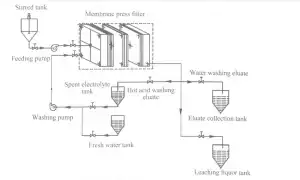
2.2 Experimental procedure The diagram of leaching and recovery of zinc from zinc calcine is presented in Fig.1.111e proper production process is described briefly as follows.1 1 leaching in stirred.tank reactor:Spent electrolyte or sulfuric acid was added to the crashed zinc calcine to leach zinc ions from the ores and to obtain the ZnS04-contained slurry.2、 filtration:the ZnS04-contained slurry was pumped into MFP through central feeding hole and filter pressed to obtain the filter cakes(i.e.,ZLR);next,the filtrate (1eaching liquor)entered the subsequent production process.3、Re.1eaching inⅣ【FP:Spent electrolyte at the desired temperature was pumped into the MFP and reacted with filter cakes to leach zinc again and simultaneously recover part of ZnS04.4)water washing: The filter cakes were washed again with flesh water to further recover ZnS04.5)pressing:Water with a pressureof 1 MPa was pumped into the membrane plates.which was maintained for 20 min to reduce the water content of filter cakes, and the pressed filter cakes were subsequently discharged from the MFP and transported to landfills.The eluate obtained from spent electrolyte washing and flesh water washing steps were collected and returned to spent electrolyte tank and eluate collection tank,respectively.
3 Results and discussion
3.1 Filter cake formation To obtain a high zinc ex仃action rate and recovery rate using an MFP.the most important step is to obtain uniform filter cakes.The particle size of zinc calcine and sedimentation time.which are directly involved with the width of the filter chambers,are the most important parameters regarding the uniformity of filter cake. Therefore,the particle sizes of zinc calcine,as well as the width of the filter chamber were firstly selected.The five—spot test(upper left,bottom left,center,upper right, bottom right)was used for estimating the uniformity of the filter cakes by measuring the zinc content and thickness of the cakes at these selected points. Through observation of the filter cakes formed in the MFP,it is found that triangle cakes were easily formed using raw zinc calcine.The particle size distribution of raw zinc calcines was measured and the corresponding result is presented in Table 1.The presence zinc calcine of large particle size inhibits the formation of uniform cakes due to its good settleability: thus,small size particles should be selected.Choosing the particle size of zinc calcine less than 106 gm仃、able 1 1。which could be obtained in actual production,a series of experiments regarding the filter cake formation were conducted.and the results are presented in Fig.2. From Fig.2,using zinc calcines with particle sizes less than 1 06 gm,the zinc content and filter cake thickness vary clearly at the five tested points when the filter chamber width is 40 mln,suggesting that the cake uniformity is poor under this condition,which might be due to long sedimentation time.When the filter chamber width is 30 lnnl.the cake uniformity is improved significantly relative to the chamber width of 40 nun. When the filter chamber width is 20 mm,the cake uniformity is similar to the results obtained as the chamber width is 30 mm.Thus.it can be clearly observed that the uniforlTl filter cakes could be formed by choosing the particle size of zinc calcine to be less than 1 06 Bm for filter chamber widths of 20 mm and 30 mill. As a result.the zinc calcines with particle size 1ess than 1 06 Bm were used in the following experiments.The processing capacity of MFP with 20 mm width chamber is 10wer than that with 30 toni width chamber.Therefore. combining the results of processing capacity and cake uniformity,the chamber width of 30 finn was selected in the following experiments.
3.2 Leaching of zinc from zinc calcine In this lcaching process.1 00 L of spent electrolyte solution was added to a 300 L stainless steel drum equipped with a variable speed stirrer and then stirred for approximately 1 h at a speed of 60 r/min.Next,the 1eaching solution was adjusted by adding zinc calcine or sulfate acid until the final Zn”concentration of electrolyte was in the range of 130-140 g/L and the final H2S04 concentration was in the range of l一2 g/L. Subsequently,the ZnS04-contained slurry was filtered using a MFE The analysis results of zinc calcine and ZLR are presented in 1’ables 2 and 3.respectively. As presented in Table 2.the grade of zinc calcine is 57.52%.in which ZnO approximately accounts for 90.06%of total zinc in mass.Table 3 indicates that in this process of leaching,most of the Zn0 is converted to ZnS04,resulting in the dramatic decrease of the content of ZnO.After solid-liquid separation using the MFP. many insoluble materials are concentrated in the residue. The content of zinc in the leaching residue is higher than 20%,causing the extraction rate of zinc in this process to be less than 90%.Analysis of ZLR indicates that zinc iS mainly presented in the forills of ZnFe204,ZnO and ZnS04,which in total account for uD to 80%of the zinc(Table 3).Thus,a secondary leaching process is required to recover the remaining zinc.
3.3 Leaching of zinc from ZLR In this leaching process,the zinc was extracted from ZLR obtained in Section 3.2 in the form of spent electrolyte washing using MFE To dissolve ZnFe204, strict leaching conditions,such as high temperature (above 90。C、and high concentration of acid solution (100—200 g/L),are required.Under hi。曲temperature and high acid concentration conditions,the extraction rate of zinc can increase to approximately 97%[19,20].To enable a comparison with the extraction rate obtained in the traditional route.the lcaching conditions in the present work are under a temperature in the range of 90 to 96 oC and an acid concentration in the range of 1 00 to 200 g/L.Becanse也e leaching residues of zinc calcine were fixed in the chamber of the MFP.the high reaction temperature condition was realized through heating of the spent electrolyte. Figure 3 shows the Zn”and H2S04 concentrations with leaching time under atemperature in the range of 90 to 96 oC during the leaching process based on MFE From Fig。3.the Zn”concentration is observed to obviously increase during the initial 5 min,followed by a decrease to 55璣after washing for 60 min and only a slight change around the level of 55 g/L in the following 30 min.Conversely’the H2S04 concentration obviously decreases during the initial 5 min.followed by an increase to 11 7 g/L after washing for 60 min and then slight changes around the level of 120 g/L in next 30 min. Based on these above results,it can be concluded that the violently reaction of the leaching residue with the hot spent electrolyte only lasts for approximately 60 min. The analysis result of the residue after hot concentrated acid leaching for 90 min is presented in T2lble 4.Clearlv. the zinc content in the residue reduces significantly from over 20%(Table 3)to less than 1 0%(Table 41.As a consequence,the zinc extraction rate 1ncreases to 97%. 碭Hs.this result obviously demonstrates that using a MFP as a leaching reactor could not only ensure a high extraction rate but also reduce the leaching time compared with the traditional hot concentrated acid leaching.The short leaching time using a MFP might be due to the constant reaction conditions of high temperature and high acid concentration during the whole process when using a MFE Based on the above results.additional experiments on the leaching of zinc from ZLR were also conducted under low temperatures,such as at 30 oC,60 to 70 oC,70 to 80 oC and 80 to 90 oC.to reduce the energy consumption further.The corresponding results are presented in Fig.4. The zinc extraction rate at 30 oC is 92.67%.and increases to 94.95%at 60 to 70。C.When the 1eaching temperature is further increased to 80 to 90。C.the ex仃action ratio increases to 95.56%.The temperature of spent electrolyte has an obvious effect on t11e zinc extraction ratio.High zinc extraction could be obtained by increasing the temperature of leaching,which is consistent wim the results of Ref.f191.Under Iow temperatures,the energy consumption is lower,the extraction ratio can not reach the traditional result of 97%.In conelusion.the hot acid leaching only at 90 to 96 oC or above can achieve the ideal result(i.e.,more than 97%、.
3.4 Recovery of water-soluble zinc
The water-soluble zinc approximately accounts for 3%of the total zinc in the residue after hot acidleaching with MFP(Table 41.To recover this part of the zinc.the leaching residue was further washed with Water. Figure 5 shows that both the Zn2+and H,S04 concentrations of eluate decrease with increasing washing time.especially in the initial 5 min.These results indicate that Zn”and H,S04 in the zinc residue could be quickly washed out by Water using the MFP. After washing for 25 min,the final Znz+and H2S04 concentrations of eluate decrease to 0.05嘰and 1.25 g/L.respectively. The final residue obtained after being washed and pressed merely contains 6%of zinc.in which the water-soluble zinc only accounts for 0.07%(Table 5), suggesting that the majority of water-soluble zinc is recovered during the water washing process.Compared with the traditional hot concentrated acid leaching process,the water-soluble zinc lost in the leaching residue iS very 10W. 3.5 Washing uniformity To estimate the washing results,the washing uniformity of MFP was examined by measuring.both the total zinc and the water-soluble zinc contents in the final residue.As presented in Rlble 6.both the total zinc and the water-soluble zinc contents change slightly at five selected points(upper left,bottom left,center,upper right,and bottom right)in the residue,indicating that the hot spent electrolyte and water washing are quite uniforiil.Therefore.the zinc that can be extracted in zinc calcine and the Water-soluble zinc that can be recovered in the residue are completely extracted and recovered by USing the MFP.
4 Conclusions
1】The use of a MFP is found to be completely feasible and effective to 1each and recover zinc from leaching residues ofzinc calcine.
2】The zinc calcines with particle size of less than 1 06 gm and MFP chambers with a width of 30 I/IlTI are proper for establishing unifornl filter cakes to obtain acceptable leaching and recovery results.
2 Experimental 623
2.1 Materials The experimental study was performed using zinc calcine with a composition of 57%zinc.which was purchased from Hunan Province。 China. Spent electrolyte containing 1 60 g/L of H2S04 and 50 g/L of Zn”was used in all of the leaching experiments.Under all examined conditions.the zinc concentration was determined based on GB/T 14353.3-2010『17],and the hydrogen ion concen仃ation fH+、was measured based on GB 6498.2-2001『181.The membrane filter press (KM470)was from Beijing ZSC Solid—Liquid Separating Technology Co.,Ltd.(China),and the membrane plates (470 ml/l×470 mill)were from LENSER Filtration GmbH+Co.(Germany).
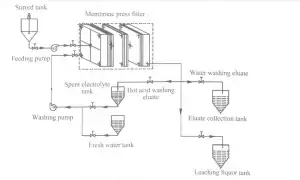
2.2 Experimental procedure The diagram of leaching and recovery of zinc from zinc calcine is presented in Fig.1.111e proper production process is described briefly as follows.1 1 leaching in stirred.tank reactor:Spent electrolyte or sulfuric acid was added to the crashed zinc calcine to leach zinc ions from the ores and to obtain the ZnS04-contained slurry.2、 filtration:the ZnS04-contained slurry was pumped into MFP through central feeding hole and filter pressed to obtain the filter cakes(i.e.,ZLR);next,the filtrate (1eaching liquor)entered the subsequent production process.3、Re.1eaching inⅣ【FP:Spent electrolyte at the desired temperature was pumped into the MFP and reacted with filter cakes to leach zinc again and simultaneously recover part of ZnS04.4)water washing: The filter cakes were washed again with flesh water to further recover ZnS04.5)pressing:Water with a pressureof 1 MPa was pumped into the membrane plates.which was maintained for 20 min to reduce the water content of filter cakes, and the pressed filter cakes were subsequently discharged from the MFP and transported to landfills.The eluate obtained from spent electrolyte washing and flesh water washing steps were collected and returned to spent electrolyte tank and eluate collection tank,respectively.
3 Results and discussion
3.1 Filter cake formation To obtain a high zinc ex仃action rate and recovery rate using an MFP.the most important step is to obtain uniform filter cakes.The particle size of zinc calcine and sedimentation time.which are directly involved with the width of the filter chambers,are the most important parameters regarding the uniformity of filter cake. Therefore,the particle sizes of zinc calcine,as well as the width of the filter chamber were firstly selected.The five—spot test(upper left,bottom left,center,upper right, bottom right)was used for estimating the uniformity of the filter cakes by measuring the zinc content and thickness of the cakes at these selected points. Through observation of the filter cakes formed in the MFP,it is found that triangle cakes were easily formed using raw zinc calcine.The particle size distribution of raw zinc calcines was measured and the corresponding result is presented in Table 1.The presence zinc calcine of large particle size inhibits the formation of uniform cakes due to its good settleability: thus,small size particles should be selected.Choosing the particle size of zinc calcine less than 106 gm仃、able 1 1。which could be obtained in actual production,a series of experiments regarding the filter cake formation were conducted.and the results are presented in Fig.2. From Fig.2,using zinc calcines with particle sizes less than 1 06 gm,the zinc content and filter cake thickness vary clearly at the five tested points when the filter chamber width is 40 mln,suggesting that the cake uniformity is poor under this condition,which might be due to long sedimentation time.When the filter chamber width is 30 lnnl.the cake uniformity is improved significantly relative to the chamber width of 40 nun. When the filter chamber width is 20 mm,the cake uniformity is similar to the results obtained as the chamber width is 30 mm.Thus.it can be clearly observed that the uniforlTl filter cakes could be formed by choosing the particle size of zinc calcine to be less than 1 06 Bm for filter chamber widths of 20 mm and 30 mill. As a result.the zinc calcines with particle size 1ess than 1 06 Bm were used in the following experiments.The processing capacity of MFP with 20 mm width chamber is 10wer than that with 30 toni width chamber.Therefore. combining the results of processing capacity and cake uniformity,the chamber width of 30 finn was selected in the following experiments.
3.2 Leaching of zinc from zinc calcine In this lcaching process.1 00 L of spent electrolyte solution was added to a 300 L stainless steel drum equipped with a variable speed stirrer and then stirred for approximately 1 h at a speed of 60 r/min.Next,the 1eaching solution was adjusted by adding zinc calcine or sulfate acid until the final Zn”concentration of electrolyte was in the range of 130-140 g/L and the final H2S04 concentration was in the range of l一2 g/L. Subsequently,the ZnS04-contained slurry was filtered using a MFE The analysis results of zinc calcine and ZLR are presented in 1’ables 2 and 3.respectively. As presented in Table 2.the grade of zinc calcine is 57.52%.in which ZnO approximately accounts for 90.06%of total zinc in mass.Table 3 indicates that in this process of leaching,most of the Zn0 is converted to ZnS04,resulting in the dramatic decrease of the content of ZnO.After solid-liquid separation using the MFP. many insoluble materials are concentrated in the residue. The content of zinc in the leaching residue is higher than 20%,causing the extraction rate of zinc in this process to be less than 90%.Analysis of ZLR indicates that zinc iS mainly presented in the forills of ZnFe204,ZnO and ZnS04,which in total account for uD to 80%of the zinc(Table 3).Thus,a secondary leaching process is required to recover the remaining zinc.
3.3 Leaching of zinc from ZLR In this leaching process,the zinc was extracted from ZLR obtained in Section 3.2 in the form of spent electrolyte washing using MFE To dissolve ZnFe204, strict leaching conditions,such as high temperature (above 90。C、and high concentration of acid solution (100—200 g/L),are required.Under hi。曲temperature and high acid concentration conditions,the extraction rate of zinc can increase to approximately 97%[19,20].To enable a comparison with the extraction rate obtained in the traditional route.the lcaching conditions in the present work are under a temperature in the range of 90 to 96 oC and an acid concentration in the range of 1 00 to 200 g/L.Becanse也e leaching residues of zinc calcine were fixed in the chamber of the MFP.the high reaction temperature condition was realized through heating of the spent electrolyte. Figure 3 shows the Zn”and H2S04 concentrations with leaching time under atemperature in the range of 90 to 96 oC during the leaching process based on MFE From Fig。3.the Zn”concentration is observed to obviously increase during the initial 5 min,followed by a decrease to 55璣after washing for 60 min and only a slight change around the level of 55 g/L in the following 30 min.Conversely’the H2S04 concentration obviously decreases during the initial 5 min.followed by an increase to 11 7 g/L after washing for 60 min and then slight changes around the level of 120 g/L in next 30 min. Based on these above results,it can be concluded that the violently reaction of the leaching residue with the hot spent electrolyte only lasts for approximately 60 min. The analysis result of the residue after hot concentrated acid leaching for 90 min is presented in T2lble 4.Clearlv. the zinc content in the residue reduces significantly from over 20%(Table 3)to less than 1 0%(Table 41.As a consequence,the zinc extraction rate 1ncreases to 97%. 碭Hs.this result obviously demonstrates that using a MFP as a leaching reactor could not only ensure a high extraction rate but also reduce the leaching time compared with the traditional hot concentrated acid leaching.The short leaching time using a MFP might be due to the constant reaction conditions of high temperature and high acid concentration during the whole process when using a MFE Based on the above results.additional experiments on the leaching of zinc from ZLR were also conducted under low temperatures,such as at 30 oC,60 to 70 oC,70 to 80 oC and 80 to 90 oC.to reduce the energy consumption further.The corresponding results are presented in Fig.4. The zinc extraction rate at 30 oC is 92.67%.and increases to 94.95%at 60 to 70。C.When the 1eaching temperature is further increased to 80 to 90。C.the ex仃action ratio increases to 95.56%.The temperature of spent electrolyte has an obvious effect on t11e zinc extraction ratio.High zinc extraction could be obtained by increasing the temperature of leaching,which is consistent wim the results of Ref.f191.Under Iow temperatures,the energy consumption is lower,the extraction ratio can not reach the traditional result of 97%.In conelusion.the hot acid leaching only at 90 to 96 oC or above can achieve the ideal result(i.e.,more than 97%、.
3.4 Recovery of water-soluble zinc
The water-soluble zinc approximately accounts for 3%of the total zinc in the residue after hot acidleaching with MFP(Table 41.To recover this part of the zinc.the leaching residue was further washed with Water. Figure 5 shows that both the Zn2+and H,S04 concentrations of eluate decrease with increasing washing time.especially in the initial 5 min.These results indicate that Zn”and H,S04 in the zinc residue could be quickly washed out by Water using the MFP. After washing for 25 min,the final Znz+and H2S04 concentrations of eluate decrease to 0.05嘰and 1.25 g/L.respectively. The final residue obtained after being washed and pressed merely contains 6%of zinc.in which the water-soluble zinc only accounts for 0.07%(Table 5), suggesting that the majority of water-soluble zinc is recovered during the water washing process.Compared with the traditional hot concentrated acid leaching process,the water-soluble zinc lost in the leaching residue iS very 10W. 3.5 Washing uniformity To estimate the washing results,the washing uniformity of MFP was examined by measuring.both the total zinc and the water-soluble zinc contents in the final residue.As presented in Rlble 6.both the total zinc and the water-soluble zinc contents change slightly at five selected points(upper left,bottom left,center,upper right,and bottom right)in the residue,indicating that the hot spent electrolyte and water washing are quite uniforiil.Therefore.the zinc that can be extracted in zinc calcine and the Water-soluble zinc that can be recovered in the residue are completely extracted and recovered by USing the MFP.
4 Conclusions
1】The use of a MFP is found to be completely feasible and effective to 1each and recover zinc from leaching residues ofzinc calcine.
2】The zinc calcines with particle size of less than 1 06 gm and MFP chambers with a width of 30 I/IlTI are proper for establishing unifornl filter cakes to obtain acceptable leaching and recovery results.
]]>
一、蘇東壓濾機的含義
蘇東壓濾機,,總部位于中國江蘇泰州。作為國內壓濾機行業的領軍企業,蘇東壓濾機專注于壓濾機、壓濾機配件以及濾板加工的銷售與服務。經過三十多年的發展,蘇東壓濾機已成為國內過濾行業的佼佼者,產品遠銷全球多個國家和地區。
二、蘇東壓濾機的技術特點
1. 高效過濾:蘇東壓濾機采用先進的過濾技術,能夠實現高效過濾,提高過濾效率,降低能耗。其獨特的濾布設計,可有效攔截液體中的雜質,滿足各種過濾需求。
2. 自動化程度高:蘇東壓濾機具備高度自動化的操作系統,減少了人工干預,降低了人工成本。自動化操作也提高了過濾過程的穩定性和可靠性。
3. 耐腐蝕性強:蘇東壓濾機的主要部件采用耐腐蝕性強的材料制造,能夠在各種惡劣的工業環境中穩定運行,有效延長了設備的使用壽命。
4. 易于維護:蘇東壓濾機在設計上充分考慮了維護和保養的需求,使得設備在日常使用中易于維護,降低了運營成本。
5. 節能環保:蘇東壓濾機在生產過程中注重節能環保,采用低能耗設計,同時減少廢水的排放,為綠色環保事業做出了積極貢獻。
三、蘇東壓濾機的應用領域
蘇東壓濾機以其卓越的性能和廣泛的應用領域而備受贊譽。其產品廣泛應用于以下領域:
1. 化工行業:在化工生產過程中,蘇東壓濾機可用于各種化學反應的固液分離,提高產品質量和收率。
2. 制藥行業:在制藥生產中,蘇東壓濾機用于提取、濃縮、結晶等工藝過程中的固液分離,保證藥品的純度和安全性。
3. 食品行業:蘇東壓濾機在食品加工領域中廣泛應用于果汁、果醬、乳制品等的過濾與澄清,提高食品品質和口感。
4. 環保行業:蘇東壓濾機在廢水處理、污泥脫水等領域發揮著重要作用,有效降低污染物排放,改善環境質量。
5. 其他領域:除了上述領域外,蘇東壓濾機還廣泛應用于冶金、電力、煤炭等其他工業領域,為各行業的過濾需求提供高效穩定的解決方案。
四、蘇東壓濾機的未來發展
隨著科技的不斷進步和市場需求的變化,蘇東壓濾機將繼續致力于技術創新和產品升級。未來,蘇東壓濾機的發展將重點關注以下幾個方面:
1. 智能化發展:加強智能化技術的研發與應用,提高設備的自動化和遠程控制水平,降低人工干預,提高生產效率。
2. 節能環保:持續優化設備能效,降低能耗和排放,積極響應國家綠色發展的號召,為全球環保事業做出更大貢獻。
3. 個性化定制:根據不同行業和客戶的特殊需求,提供個性化的產品定制服務,滿足市場的多樣化需求。
4. 拓展應用領域:進一步拓展蘇東壓濾機的應用領域,探索其在新能源、新材料等新興領域中的應用潛力。
5. 國際市場拓展:加強國際市場的開拓與布局,提升蘇東壓濾機在國際上的知名度和競爭力,推動中國制造走向世界。
總結來說,蘇東壓濾機作為國內壓濾機行業的佼佼者,在技術研發、產品創新、市場拓展等方面取得了顯著成果。未來,隨著智能化、節能環保等技術的發展以及應用領域的不斷拓展,蘇東壓濾機將繼續引領過濾行業的技術革新,為全球過濾需求提供更加高效、穩定、環保的解決方案。
]]>一、壓濾機的用途
壓濾機主要應用于以下領域:
1. 污水處理:在污水處理領域,壓濾機主要用于污泥脫水。經過生物反應池和沉淀池處理后的污泥,通過管道輸送到壓濾機中進行脫水。壓濾機通過施加壓力,使污泥中的水分被擠出,從而實現污泥的脫水。脫水泥餅可以進行進一步處理或利用。
2. 化工:在化工領域,壓濾機主要用于固液分離。例如,在生產硫酸、化肥等化工產品時,需要將原料中的固體物質與液體進行分離,此時可以使用壓濾機進行分離。
3. 冶金:在冶金領域,壓濾機主要用于對礦漿進行固液分離。通過壓濾機可以將礦漿中的有用礦物和廢石等固體物質進行分離,提高礦物的利用率。
4. 環保:除了上述領域外,壓濾機還廣泛應用于環保領域。例如,在處理工業廢水、城市污水等方面,可以使用壓濾機進行固液分離,使處理后的水質達到排放標準。
二、壓濾機的工作原理
壓濾機主要由進料泵、過濾網、壓緊機構和液壓系統等部分組成。其工作原理如下:
1. 進料泵將液體和固體混合物輸送到壓濾機的過濾網中。
2. 過濾網的作用是將固體物質截留在其表面,而液體則通過過濾網流出。此時,固體物質被壓縮在過濾網的表面形成濾餅。
3. 壓緊機構將過濾網室兩側的板框壓緊,以產生一定的壓力。隨著時間的推移,壓力逐漸增大,使濾餅中的水分被擠出。
4. 液壓系統是壓濾機的動力源,通過液壓油推動活塞桿和板框的運動,實現過濾和壓緊等功能。
5. 當達到預設的過濾時間或壓力時,壓濾機自動卸荷,將過濾網室兩側的板框松開。隨后,過濾網上的濾餅被刮刀刮下并排出,完成整個過濾過程。
三、壓濾機的優勢
1. 高分離效率:壓濾機采用高壓過濾技術,可以在短時間內完成大量固液混合物的分離。
2. 節能環保:相對于傳統的沉淀池和離心機等分離方法,壓濾機在運行過程中能耗較低,且產生的污泥量較少,有利于環保。
3. 自動化程度高:現代壓濾機大多采用智能控制系統,可以實現自動進料、自動控制壓力和時間等功能,減少了人工操作和提高了生產效率。
4. 應用范圍廣:由于其高效、節能和環保等特點,壓濾機在各個領域都有廣泛的應用前景。
壓濾機作為一種高效、節能的固液分離設備,在廠子里的應用十分廣泛。其工作原理主要是通過施加壓力使液體和固體混合物中的固體物質被截留在過濾網上,并形成濾餅,同時液體通過過濾網流出。經過一段時間后,壓緊機構松開,刮刀將濾餅刮下并排出,完成整個過濾過程。在污水處理、化工、冶金、環保等領域中,壓濾機都發揮著重要的作用。隨著技術的不斷進步和應用需求的增加,未來壓濾機的性能和功能將得到進一步提升和完善。
]]>一、大連壓濾機入料泵價格影響因素
大連壓濾機入料泵的價格因多種因素而異,其中主要因素包括設備型號、規格、材料、功能和廠家品牌等。
1. 設備型號與規格
不同型號和規格的大連壓濾機入料泵具有不同的性能和參數,因此價格也不同。一般來說,型號越大、規格越高的入料泵價格越高。
2. 設備材料
大連壓濾機入料泵的材料質量對其性能和使用壽命有著重要影響。優質的材料能夠提高設備的耐腐蝕性、抗壓性和穩定性,但價格也相對較高。常見的材料有不銹鋼、碳鋼等。
3. 設備功能與配置
大連壓濾機入料泵的功能和配置也是影響價格的重要因素。例如,自動控制、遠程監控、加熱保溫等功能和配置會增加設備成本,從而推高價格。
4. 廠家品牌與口碑
知名品牌和良好口碑的廠家通常能夠提供更高質量的壓濾機入料泵,但價格也相對較高。而一些小廠家或不知名品牌可能會提供價格相對較低的產品,但質量和售后可能無法保證。
二、大連壓濾機入料泵的價格范圍
根據以上因素,我們可以大致給出大連壓濾機入料泵的價格范圍:
1. 入門級:通常在10萬元以下,適用于小型企業和初創企業,性能和配置相對較低。
2. 中檔型:價格在10萬元至50萬元之間,適用于中等規模的企業和需要一定性能的場合,性能和配置相對較高。
3. 高端型:價格在50萬元以上,適用于大型企業、高要求場合或特殊用途,性能和配置非常高。
需要注意的是,以上價格僅為大致參考,實際價格還需根據具體型號、規格、材料、功能和配置進行確定。購買大連壓濾機入料泵時,建議多方比較、了解市場行情,并選擇正規、有資質的廠家進行購買,以確保質量和售后服務的可靠性。
三、如何選購合適的大連壓濾機入料泵
在選購大連壓濾機入料泵時,除了關注價格之外,還需要注意以下幾個方面:
1. 了解自身需求:根據實際生產需求和物料性質,選擇適合的型號和規格的壓濾機入料泵。例如,需要處理何種液體和固體混合物、過濾面積和過濾壓力的要求等。
2. 考察廠家實力:選擇正規、有資質的廠家進行購買,了解其生產能力、產品質量、售后服務等方面的信息。可以通過實地考察、參觀樣板工程、了解客戶評價等方式進行評估。
3. 比較不同產品:多方比較不同型號、規格、材料、功能和配置的大連壓濾機入料泵,找出性價比最高的產品。不要只看價格,也要關注質量和性能等因素。
4. 遵循安全規范:確保選購的大連壓濾機入料泵符合國家和行業安全規范,能夠安全穩定地運行,避免因設備故障或操作不當引起的安全事故。
5. 考慮長期維護與成本:除了購買成本外,還需要考慮設備的長期維護成本和使用壽命。選擇質量可靠、易于維護的設備能夠降低長期運營成本。
6. 簽訂正規合同:在購買大連壓濾機入料泵時,要與廠家簽訂正規的銷售合同,明確設備的型號、規格、質量保證、售后服務等內容,以便在后續出現問題時能夠保護自己的權益。
選購合適的大連壓濾機入料泵需要考慮多方面因素,包括價格、性能、質量、廠家實力等。只有綜合考慮這些因素,才能選擇到適合自己需求的入料泵,為企業的生產提供穩定可靠的保障。在具體選擇過程中,還需要結合企業自身實際情況進行評估和決策,以便更好地滿足實際生產需求。
]]>一、大型機械設備市場
大型機械設備市場是出售高壓圓板壓濾機的主要場所之一。這些市場通常集中了眾多的機械設備生產和銷售商家,他們為了滿足客戶的需求,會提供各種型號和規格的高壓圓板壓濾機。在這些市場購買設備,可以比較不同商家的產品性能、價格和服務,從而選擇最適合自己的設備。
二、在線電商平臺
隨著電子商務的興起,許多商家選擇在在線電商平臺上銷售高壓圓板壓濾機。通過電商平臺,客戶可以方便地瀏覽不同商家的產品,比較價格和規格,并選擇適合自己的型號。電商平臺上的商家通常提供送貨上門服務,為客戶節省了時間和精力。一些知名的在線電商平臺如阿里巴巴、京東等都有出售高壓圓板壓濾機的商家。
三、廠家直銷
除了市場和電商平臺外,直接從廠家購買也是獲取高壓圓板壓濾機的一種方式。有些廠家為了拓展銷售渠道,會設立直銷部門或通過網絡營銷的方式直接與客戶建立聯系。從廠家直接購買可以避免中間商的環節,獲得更優惠的價格。與廠家直接溝通還能更好地了解設備的生產過程和工藝,有助于客戶更好地選擇和使用設備。
四、二手市場
在二手市場也有可能出現高壓圓板壓濾機的身影。一些企業或個人由于更新設備或資金問題,會將之前使用過的設備進行出售。雖然二手市場上的設備可能存在一定的磨損或老化情況,但價格相對較低,對于一些預算有限的客戶來說是一個不錯的選擇。在二手市場購買時,建議客戶仔細檢查設備的性能和狀況,確保其滿足自己的使用要求。
五、展會和展覽會
展會和展覽會是展示各類機械設備的場所,高壓圓板壓濾機也會在這些活動中得到展示和銷售。在這些展覽會上,客戶可以親眼看到設備的實物,了解其外觀和性能,同時還能與生產商直接交流,獲取更多的產品信息和使用建議。通過展會和展覽會購買設備,可以更全面地了解市場上的產品和技術動態。
高壓圓板壓濾機可以在大型機械設備市場、在線電商平臺、廠家直銷、二手市場以及展會和展覽會上購買。客戶可以根據自己的需求和實際情況選擇最適合的購買方式。在購買過程中,建議客戶仔細了解產品的性能、價格和服務,確保自己獲得滿意的產品和服務。也建議客戶選擇有信譽的商家和廠家進行購買,以保障自己的權益。
]]>